Movements / 2 min read
Quartz vs automatic: lose the snobbery, find your watch.
One runs on a regulated electronic pulse. The other on a spring. Neither needs your permission to be brilliant.
TICKOFF Editorial /
01
The answer, without the ceremony
Choose quartz if you want grab-and-go timekeeping with less day-to-day attention. Choose an automatic if the physical mechanism, winding ritual and mechanical character are part of the attraction. There is no universal winner. The right movement is the one whose habits you actually enjoy living with.
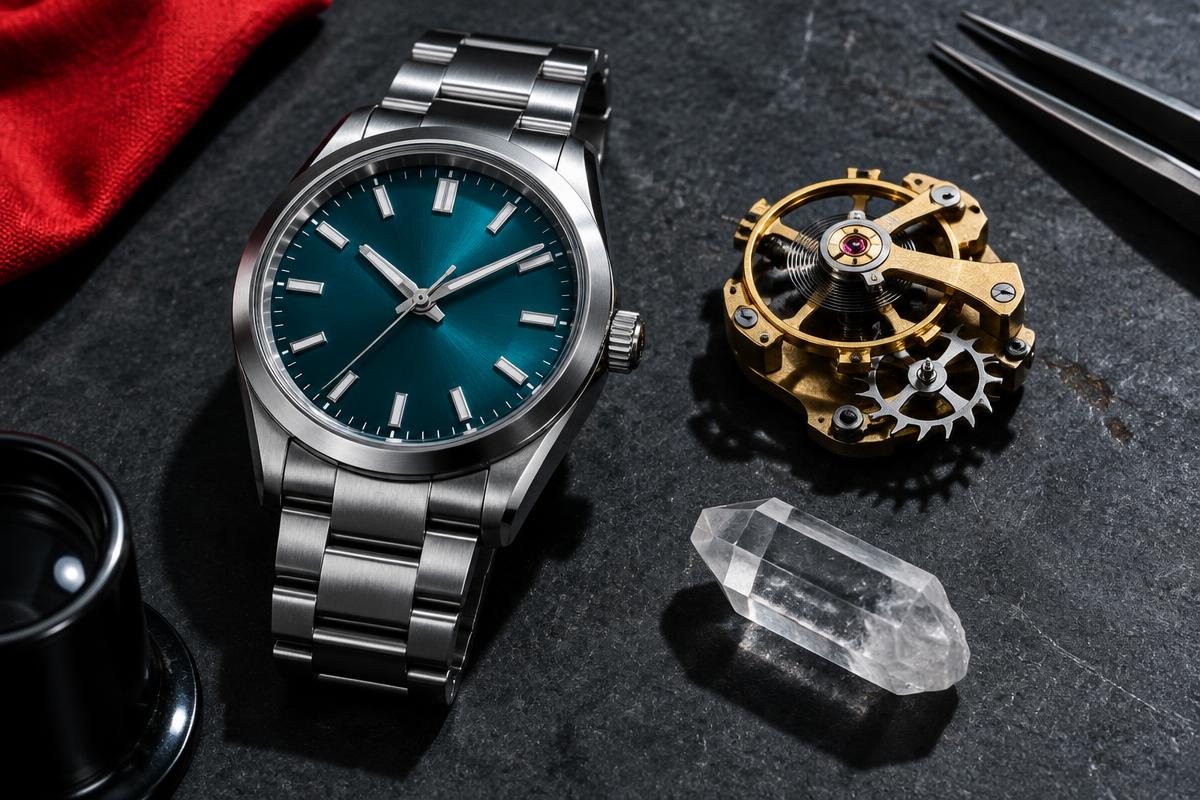
A quartz watch uses an electronic oscillator to regulate time; many run on a replaceable battery, while others use rechargeable systems. An automatic is a mechanical watch whose rotor helps wind its mainspring as it moves. Both still need care. Neither is an excuse to ignore the instructions.
02
What changes on your wrist
A mechanical watch has a finite power reserve. Leave it unworn long enough and it stops; you may need to wind it and reset the time. How long it runs, how it should be wound and whether it supports manual winding are model-specific. Read the actual specification instead of borrowing one from another watch with a similar dial.
Quartz usually demands less interaction between services, but battery or charging requirements vary. A solar-powered quartz watch is not the same ownership proposition as a conventional battery-powered one. Check what powers the specific reference, not just the word quartz.
03
Buy for your routine, not the argument
If you rotate through several watches, think about whether resetting a stopped mechanical piece sounds satisfying or irritating. If you wear one daily, think about the maintenance you are willing to arrange. Comparing movement types is useful; pretending one proves superior taste is not.
Before choosing, verify the stated movement, power source and care instructions. Our collection contains individual product descriptions, not a promise that every model uses the same mechanism. Start there. The specification matters more than the mythology.
Enough reading. Find your next obsession.
Strap up